What Customer Service Outsourcing Costs in 2026.

Key takeaways
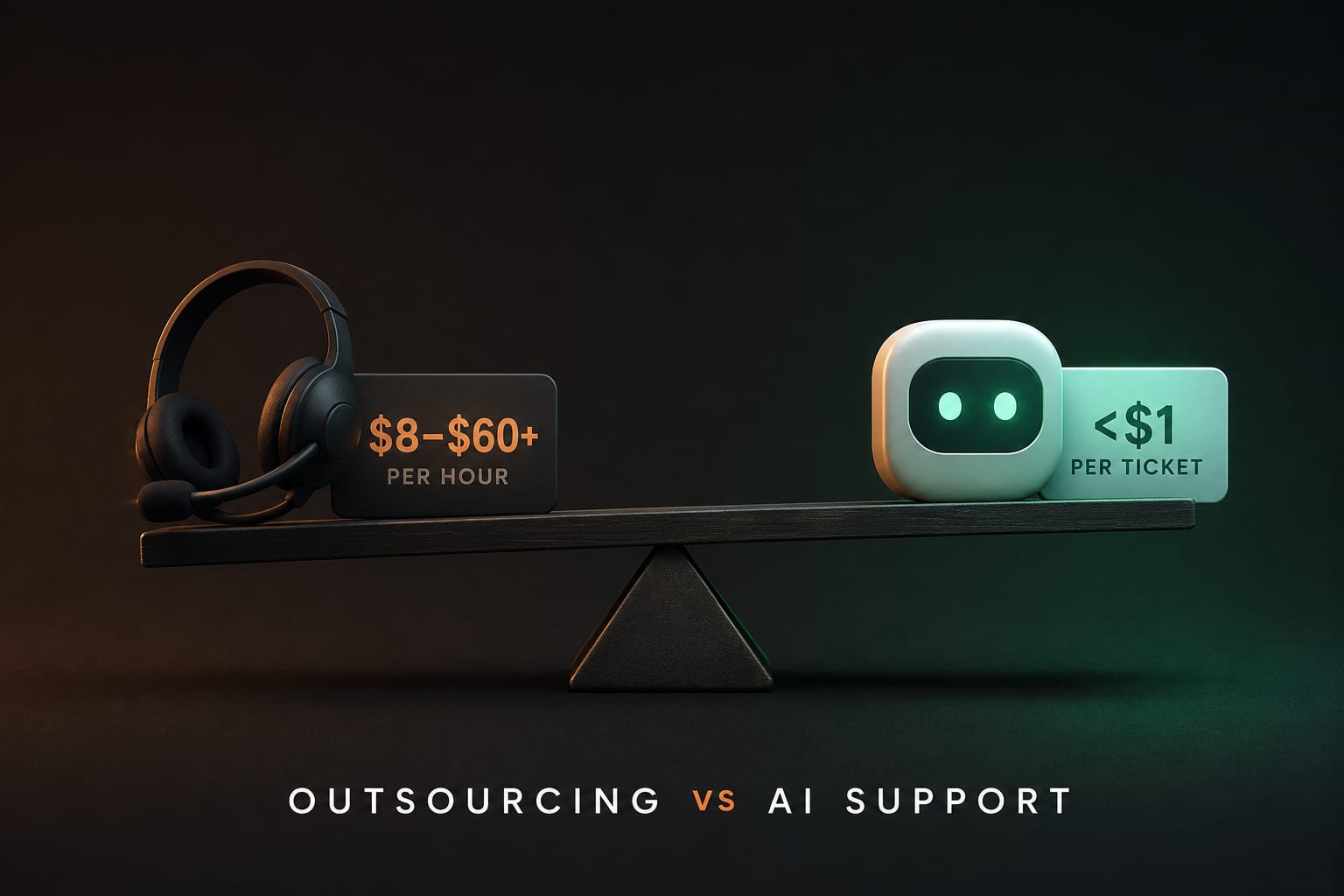
- Outsourcing runs $8 to $60+ an hour depending on where the agents are based. Pay-per-resolution runs $1 to $7 a ticket.
- AI-based support costs under $1 a ticket, according to the vendors selling it. Worth testing against your own numbers, not taking on faith.
- The real risk isn't price. It's turnover. Agents change often enough that you're quietly paying to retrain someone new.
- AI isn't cheap outsourcing. It's a different tool for different tickets, good at routine and bad at messy or emotional.
- Most businesses in 2026 run a hybrid: AI on the routine stuff and a smaller human team on the rest.
Most outsourcing pricing pages hide the number you actually want behind a "request a quote" form. Here it is upfront.
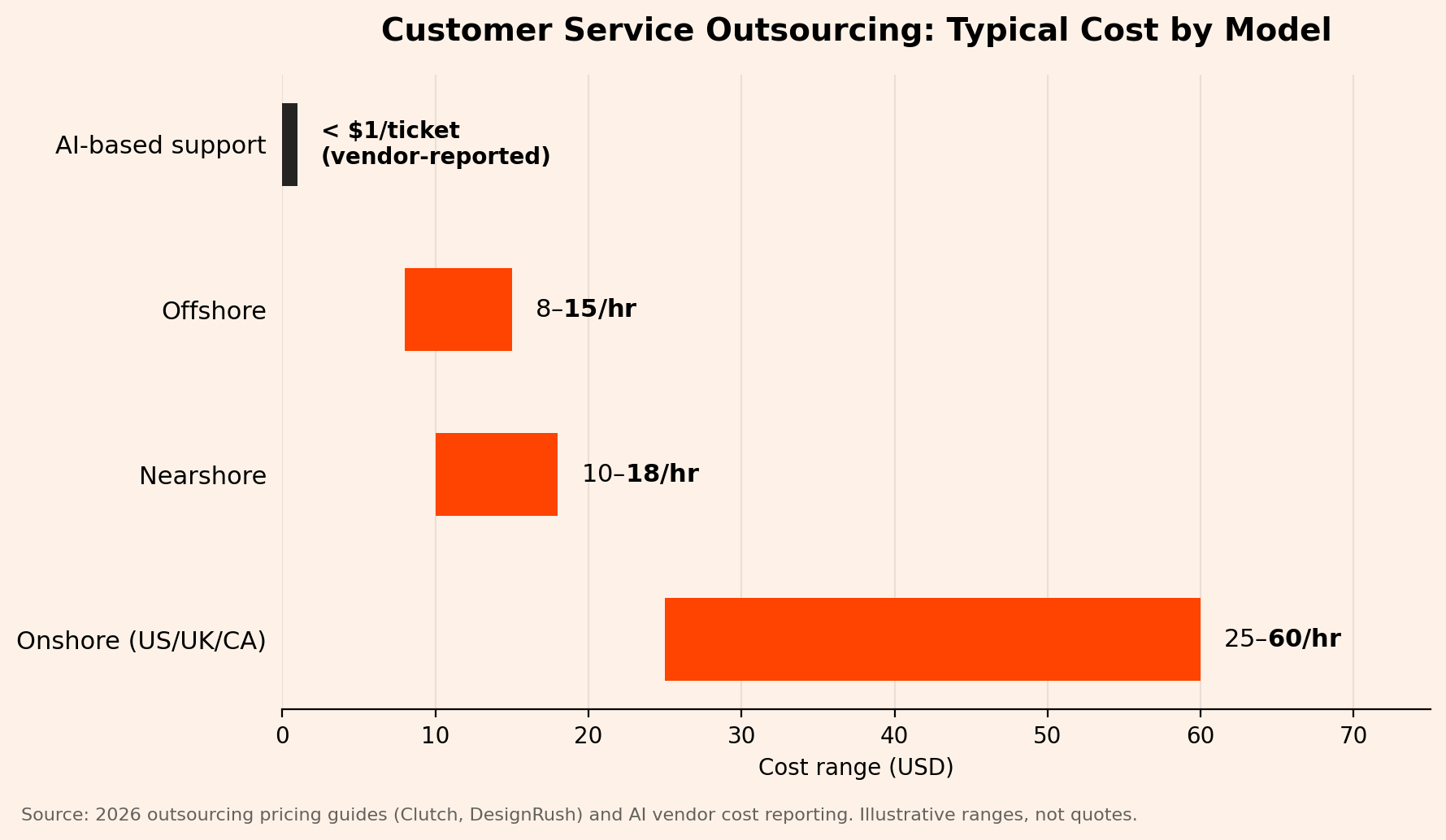
Outsourced customer service runs $8 to $60 or more an hour, depending on where the agents are based. Pay-per-resolution models run $1 to $7 a ticket. AI-based support comes in under $1 a ticket, according to the vendors selling it.
None of that tells you which one is right for your business. That depends on your ticket volume, your budget, and how much control you're willing to hand to someone outside your company.
What "customer service outsourcing" means
Outsourcing means hiring a third party to answer your customers instead of doing it yourself. Simple enough. The confusion starts with the labels.
'Offshore' agents are based somewhere with a lower cost of living, usually the Philippines, India, or Eastern Europe. 'Nearshore' is the same idea, closer to your time zone, usually Latin America if you're a US business. 'Onshore' means agents in your own country. It costs more, and it buys you less language and culture friction.
There's also a difference between a call center and a BPO. A call center handles phone calls. A BPO (business process outsourcing provider) handles phone, email, and chat, and usually throws in reporting and CRM integration too. Almost every company selling "customer service outsourcing" today is a BPO, not a plain call center.
Then there's AI-based support, the newest option. It's not a cheaper version of the other three. More on that below.
What it actually costs
Clutch's 2026 pricing analysis puts average outsourced rates at $25 to $49 an hour for US-based providers, with offshore rates running well below that.
Here's the full breakdown by model.
Model | Typical rate | Best fit |
|---|---|---|
Offshore | $8–$15/hour | High-volume, cost-first support |
Nearshore | $10–$18/hour | US time zone overlap, still cheap |
Onshore (US/UK/CA) | $25–$60+/hour | Regulated work, native-language nuance |
Pay-per-resolution | $1–$7/ticket, avg ~$4 | Usage-based, predictable billing |
AI-based support | Often under $1/ticket, plus a flat monthly fee | High-volume, repetitive questions |
DesignRush's breakdown of 70-plus outsourcing providers puts small business budgets at $1,000 to $5,000 a month, climbing to $20,000 or more once you're at enterprise scale with dedicated teams and compliance work.
None of those numbers include setup fees, onboarding, or the retraining cost that comes from turnover. Ask for those in writing before you sign anything. If a provider won't put a number on it, that tells you something too.
A quick worked example
Say your business handles about 800 support tickets a month.
Crescendo, an AI support vendor, pegs the 2026 industry average for pay-per-resolution outsourcing at about $4 a ticket. At that rate, 800 tickets runs roughly $3,200 a month. Lorikeet, a competing AI platform, reports resolving comparable tickets for under a dollar each, which would put the same volume under $800 a month plus a flat platform fee.
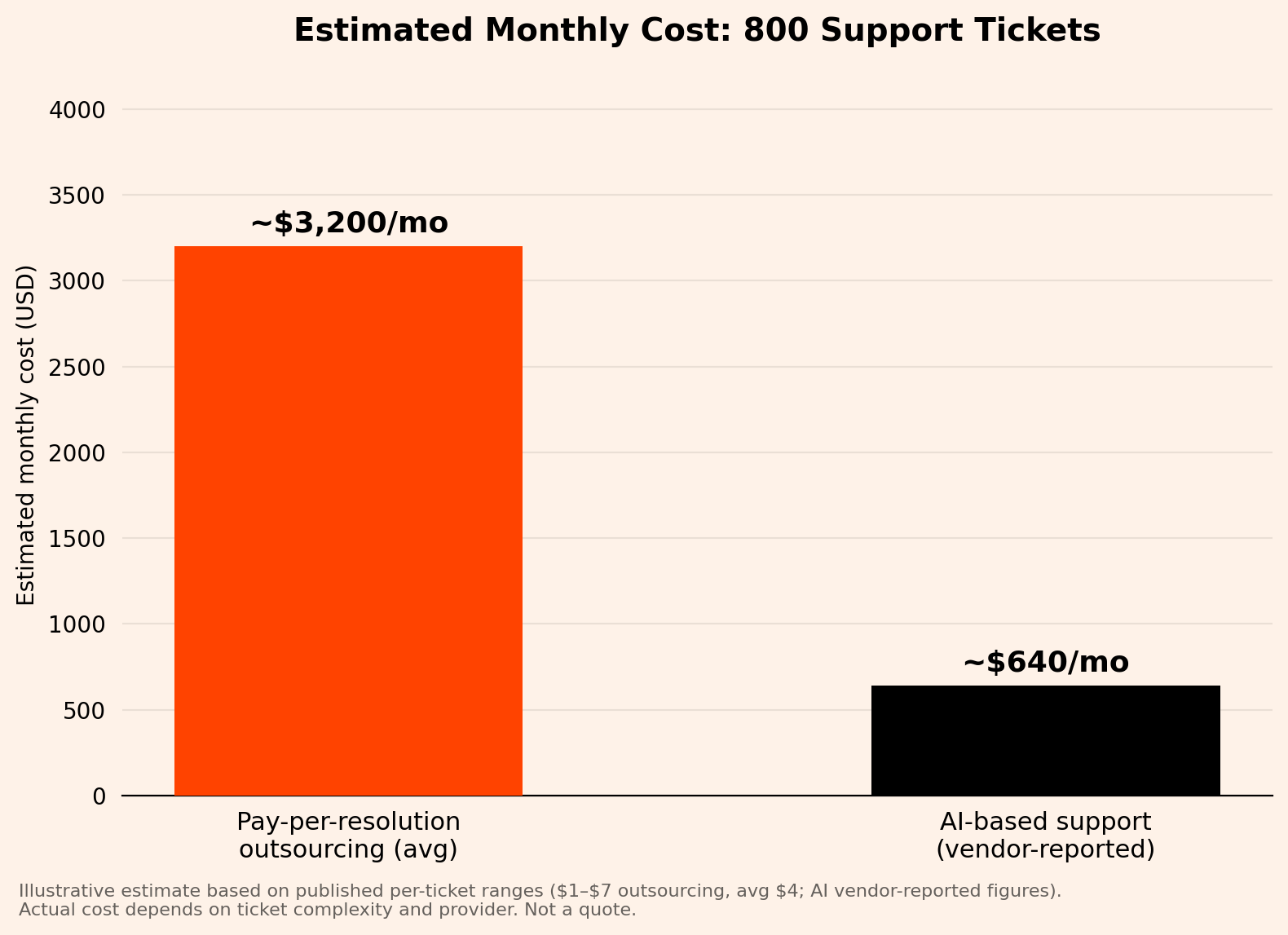
The gap looks huge on a chart. In practice, some share of those 800 tickets won't resolve cleanly through AI alone, and both numbers above come from companies selling one side of this comparison. Treat them as a starting point, not gospel. That's why most businesses don't go 100% one way.
Why businesses outsource in the first place
The pitch is simple, and for a lot of businesses, it's accurate.
Building an in-house team costs salaries, benefits, management time, and training, before a single ticket gets answered. Outsourcing turns a fixed cost into a variable one tied to volume.
It also buys coverage. One outsourced or AI setup can run nights and weekends without anyone working a graveyard shift. And it lets you handle a busy season without a hiring cycle; you'll have to unwind three months later.
The risks nobody puts in the pitch deck
Outsourcing works for plenty of companies. It also comes with real risk that rarely comes up on the sales call.
Quality drift. You're not in the room anymore. Even a good provider drifts from your tone without active management from your side.
Turnover. Dooza, an AI customer support vendor, cites annual turnover in outsourced centers running 30 to 45 percent. Take that with the same grain of salt as any vendor stat, but even the low end means the agent who learned your product in month one might be gone by month four. You pay for the retraining.
Hidden fees. Setup costs, QA monitoring, and remediation after service failures all stack on top of the hourly number. Businesses that compare providers on hourly rate alone are usually the ones who feel misled later.
Communication gaps. Matters more if your product needs nuance or regulatory precision. Matters less for simple, transactional support.
None of this means don't outsource. It means know the risk before you sign, not after.
Red flags when you're evaluating a provider
Pricing noticeably lower than everyone else with no clear reason why
No named client references you can actually call
Vague answers about agent turnover or ramp-up time
No willingness to run a small pilot before a full contract
Contract terms that are one-sided on cancellation or SLA penalties
If two or more of these show up in a sales conversation, keep looking.
Where AI customer support actually fits
This usually gets framed as AI versus outsourcing. Wrong frame. AI is a fourth option next to offshore, nearshore, and onshore. It's not "outsourcing but cheaper".
AI is strong at high-volume, repetitive, well-defined questions: order status, booking, hours, pricing, basic troubleshooting. It answers instantly, runs 24/7, and has no turnover problem because there's no agent to lose.
Take a real estate brokerage fielding after-hours property questions. Most of those calls are routine: is the listing still up, what are the viewing hours, what's included. AI can handle that volume without anyone on call at 9pm, and pass anything that turns into a real negotiation straight to a human. That's what AI customer support actually looks like in practice, not a replacement for every conversation your business has.
Here's where it doesn't fit yet: complex, emotionally loaded, or genuinely first-time situations that don't match a pattern. A frustrated customer with an unusual problem needs judgment, not a script.
Who this is for: businesses with a real chunk of repetitive, predictable tickets and the willingness to route the rest to a human.
Who this isn't for: businesses where almost every ticket is genuinely unique, high-stakes, or requires deep relationship context. AI won't save you money there; it'll just create a bad first impression before a human fixes it.
What most businesses actually run in 2026 is a hybrid. AI takes the routine majority; a smaller human team, in-house or outsourced, handles the rest.
How to actually decide
Match the model to your ticket volume and complexity. Not to whatever the provider's sales deck recommends.
Under ~50 tickets a week, mostly routine: start AI-first with a human safety net. Outsourcing minimums rarely pencil out at this volume anyway.
50 to 300 tickets a week, mixed complexity: hybrid setup. AI on tier-one, a small dedicated team on escalations.
300+ tickets a week, regulated or high-stakes: traditional outsourcing, or an enterprise AI plus BPO hybrid. At this volume, negotiate turnover guarantees and QA commitments into the contract itself, not a verbal promise.
What to do next
Pull your last three months of tickets and sort them by how routine they actually were. Most businesses overestimate how many of their tickets need a human. That number, not the provider's pitch, should drive the decision.
Not sure where your business lands? Get a free AI audit from Rewdle and see where automation actually saves you money before you sign a contract with anyone.
FAQ
Can I use AI customer support and outsourcing at the same time?
Yes, and most businesses end up doing exactly that. A common setup routes routine tickets to AI first, then escalates anything unresolved to an in-house rep or an outsourced provider on standby. The two aren't mutually exclusive, they're usually run together.
What happens when AI can't answer a customer's question?
A well-built setup escalates automatically with the full conversation history attached, so the human picking it up isn't starting from zero. Weaker setups just dead-end the customer or loop them back to a menu. Ask any provider exactly what their escalation path looks like before you commit.
How long does it take to switch from outsourcing to AI customer support?
Basic setups covering FAQs and simple lookups can go live in a week. Anything needing deep integration with your booking system, CRM, or inventory takes longer, often one to four weeks, depending on how messy your existing data is.
Do outsourced customer service agents have access to my business systems?
Usually yes, to whatever's needed to do the job, your CRM, order system, or booking calendar. That access is exactly why vetting a provider's data security practices matters as much as their pricing. Ask about access controls and what happens to your data if you end the contract.
What's a typical contract length for customer service outsourcing?
It varies, but many BPOs still push for 6 to 12 month minimums, especially for onshore or dedicated-agent setups. More providers now offer flexible, pay-per-ticket arrangements with no long lock-in, worth asking for directly if commitment is a concern.
Founder & CEO of Rewdle
I'm Ziyan, Founder & CEO of REWDLE. I'm 20 years old, based in Lahore, and I build AI systems (agents, automations, and voice AI) that help businesses cut costs and operate better. Before Rewdle, I grew The AURA TIMES to 30,000+ followers and 100M+ views. I write about what actually works, not what sounds good in a pitch.