Property Management Answering Service: What It Actually Costs and How to Choose One

Key takeaways
- A missed leasing call costs about $1,000.
- Traditional services: $175 to $470/month, plus hidden fees.
- AI-powered: $50 to $250/month, no overage surprises.
- Traditional breaks on industry gaps, per-minute traps, and generic scripts.
- Ask cost per handled call, not monthly fee.
- Math works at 30+ units with regular missed calls.
A missed leasing call costs about $1,000 in lost rental income.
That's the number every property manager runs into once they start pricing answering services. Not "24/7 coverage." Not "brand consistency." The dollar cost of every call that goes to voicemail.
Rently's 2026 Renter Touring Expectations Report puts it plainly: a 30-minute delay in responding to a rental inquiry drops the renter's engagement rate from 40% to 10%. Wait longer, get less.
So what does a property management answering service actually cost, and does it recover more revenue than it eats?
Here's the honest version.
What a property management answering service actually does
A property management answering service picks up your phones when you can't.
That's the whole product.
It covers tenant maintenance calls at 11pm. Leasing inquiries during showings. Owner questions on weekends. Anything that arrives when your team is elsewhere.
The service takes a message, transfers the call, dispatches a vendor for a real emergency, or schedules a follow-up. Good ones sit on top of your property management software (AppFolio, Buildium, Yardi, Rent Manager) so a call about a leaking water heater becomes a work order, not a sticky note.
Three shapes exist in 2026. Their pricing looks nothing like each other.
Traditional call center. Human agents in shared pools. Fine for messages. Slow on technical calls.
Dedicated property management answering service. Agents specifically trained on the industry. More expensive per minute. Fewer mistakes.
AI-powered property management answering service. A voice model handles the call, logs it into your PM software, and hands off to a human only when it needs to. Cheapest per call. Fastest growing.
Which one fits depends on your call volume and how much revenue is walking out the door right now.
What a property management answering service actually costs in 2026
Traditional call-center answering services for property management sit at $175 to $470 per month for standard volume. Entry plans start around $245 per month for 50 receptionist minutes, and push to 500 minutes and you're at $1,700 or more.
Per-minute rates run $1.30 to $1.49 on average, dropping to $0.90 to $1.25 if you commit to a longer contract. Per-call pricing averages $1.39 nationally, up to $2.15 for complex calls.
Real vendor numbers, since ranges get hand-wavy fast:
Smith dot ai: from $292.50 per month for 30 calls. Overages $9.75 to $11 per call.
Ruby: from $235 per month for 50 minutes.
NextPhone (AI): $199 flat per month.
Goodcall (AI): $59 to $249 flat per month.
Retell AI: pay-as-you-go, about $0.07 per minute.
Marble: $50 per property per month with no per-minute fees.
Now the fees vendors bury below the fold.
Setup runs $50 to $500 one-time. Holiday coverage costs 1.5x to 2x normal rates, and after-hours calls carry a 25% to 50% markup at most traditional services. Patch and transfer fees are $0.50 to $1.50 per call, and integration or technology fees show up on some invoices as line items nobody signed up for.
The sticker price on a property management answering service is almost never the number that lands on your card.
So the useful question isn't "what's the monthly fee." It's "what's my true cost per handled call, all-in, compared to the $1,000 I lose every time a leasing call hits voicemail."
Where traditional property management answering services fall short
Three failure modes. If you've run with one for a year, you've probably felt all three.
The industry gap. A generic agent doesn't know your escalation rules, doesn't know your leasing scripts, doesn't know which vendors handle a burst pipe versus a broken lock.
The call gets logged. The work still lands on your desk in the morning.
You paid for coverage. You bought a message service.
The per-minute trap. Traditional pricing scales with your demand.
Peak leasing season is when you can least afford surprise overages. Every long emergency call adds cost. Every tenant who calls twice about the same issue gets billed twice.
The tenant experience gap. A generic script read by a shared agent doesn't sound like your team. It sounds like an outsourcing desk.
For a business built on renewals and reviews, that gap is expensive.
The category is being rebuilt right now because of exactly these three gaps, which is why the choice really comes down to three models now, not one.
In-house vs. outsourced vs. AI-powered: how to decide
Don't ask "which vendor." Ask "which model."
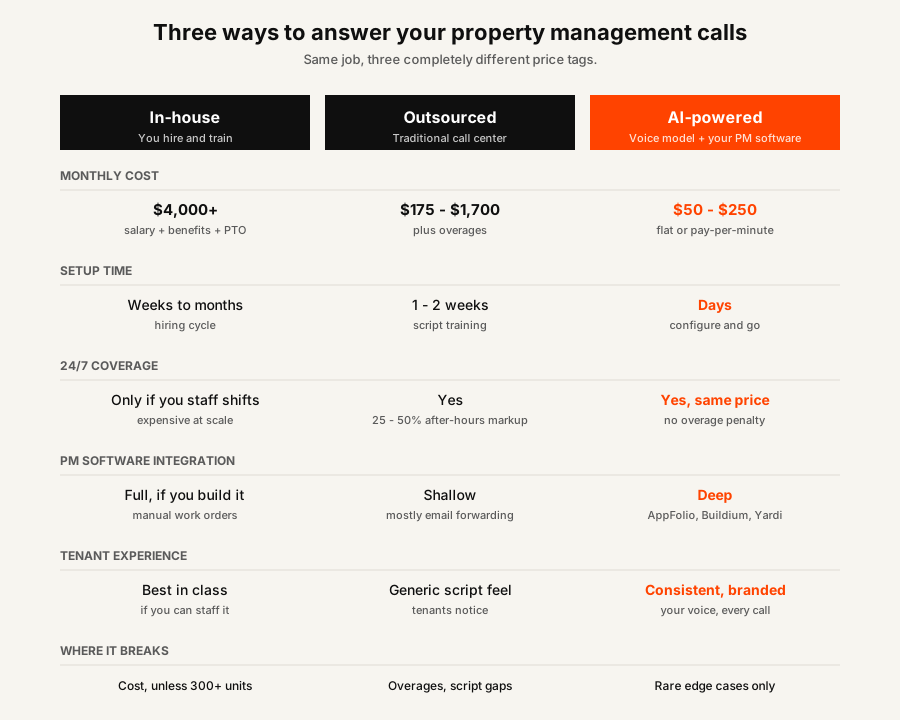
Same job, three completely different price tags. AI-powered is where the pricing math has moved in the last twelve months.
In-house. Hire your own person or team.
Fully controllable. Deeply on-brand. Most expensive by a wide margin once you count wages, benefits, PTO coverage, and off-hours differentials.
Works at 300+ units where volume supports a real role. Doesn't work at 50 to 200.
Outsourced (traditional call center). Easiest to buy, which is why most property managers land here by default. Real coverage, especially after hours, but uneven quality and shallow PM software integration. The invoice never matches the sticker.
AI-powered. A voice model handles the call end to end, integrates with your PM software, dispatches per your rules, and escalates to a human only when needed.
Flat plans from $50 to $200 per month, or pay-as-you-go from $0.07 per minute.
No surprise overages when volume spikes.
The right choice isn't universal.
Large in-house teams with real operational culture: the human option still wins on nuance.
Mid-size property management companies juggling everything: an AI-powered property management answering service is almost certainly cheaper and captures more leases than a traditional one.
Questions to ask before you sign a contract
Six questions most buyers skip until it's too late.
What's the true all-in monthly cost, including likely overages and hidden fees? Ask for a per-handled-call number, not a monthly minimum.
How does the service integrate with my property management software specifically? "We integrate with everything" is not an answer. Ask which fields sync, in which direction, and how a maintenance emergency lands in your work order queue.
What's the escalation rule for a real emergency? A water leak at 2am should trigger a dispatch to your vendor, not a voicemail on your phone.
Who owns the call recordings and transcripts? Increasingly relevant for both training and legal exposure.
What's the cancellation policy and contract length? Some traditional providers still lock in 12 months. AI-powered ones are typically month-to-month.
What's your average pickup time, first-call resolution rate, and monthly missed-call rate? If a vendor can't answer this in numbers, they're not measuring their own service.
Any one of these is worth more than the dashboard tour they want to give you.
The questions that actually decide it
Different from the checklist above. Same topics, different angle.
Do property management answering services integrate with AppFolio, Buildium, Yardi, or Rent Manager?
The good ones do. Ask specifically about work order creation, resident lookup, and vendor dispatch.
Those are the three integrations that matter most. Anything shallower is basically an email forwarder.
Can a property management answering service actually handle a real maintenance emergency?
The dedicated ones can, if they're set up correctly.
That means your escalation rules, your vendor dispatch tree, and your after-hours protocols are all loaded into the service before it takes its first call.
If the vendor won't do proper onboarding on this, expect emergencies to become your problem again.
What's the minimum portfolio size where a property management answering service actually pays for itself?
At 30 or more units with routine missed calls, the math already works.
Given the $1,000 per missed leasing call number, you don't need many capture wins to recover a $200 to $500 monthly cost.
How is an AI-powered property management answering service different from a chatbot?
A chatbot lives on your website.
An AI-powered property management answering service picks up your phone, holds a real voice conversation, follows your rules, and writes the outcome into your PM software.
Different category entirely.
Ready to price a property management answering service for your portfolio?
If you want an honest walk-through of what one would cost for your specific portfolio, and which of the three models actually fits your call volume, book a free AI opportunity call.
No sales team. Just a straight conversation.
Industry research points the same direction: property managers report some of the highest missed-call rates of any sector, and industry data on missed business calls shows how quickly a slow response turns into a lost lead.
Founder & CEO of Rewdle
I'm Ziyan, Founder & CEO of REWDLE. I'm 20 years old, based in Lahore, and I build AI systems (agents, automations, and voice AI) that help businesses cut costs and operate better. Before Rewdle, I grew The AURA TIMES to 30,000+ followers and 100M+ views. I write about what actually works, not what sounds good in a pitch.