Will AI Take Your Job? What the Data Actually Shows


Key takeaways
- AI is not causing mass unemployment. OECD unemployment is 4.9%, and BLS still projects software developer jobs to grow 15% by 2034.
- The real story is the entry level. Stanford found employment for developers aged 22–25 is down ~20% since 2024, while workers 30+ at the same firms are up 6–12%.
- 51% of companies told McKinsey that generative AI is reducing their need for entry-level hires.
- AI takes tasks, not jobs. But entry-level jobs are a bundle of exactly the tasks AI is best at, so the effect is the same.
- Three moves that actually work: use AI daily until you are fluent; build the judgement and trust AI can't copy; and learn to operate AI (build systems), not just prompt it.
You've probably asked yourself this at least once in the last few years. Maybe more than once. That AI will take my job, but i'll give you the answer of this.
The short answer is no. AI is not going to take your job.
Not next quarter. Probably not next year. And when it does start eating jobs at scale, you'll see it coming from a long way off.
But that's the boring answer.
The interesting answer, the one nobody in your feed is saying clearly, is that AI is already doing something quieter to work right now. It matters a lot more than the headlines, and if you're under 30, it might already be affecting you without you noticing.
Here's what the actual data says.
The stat that changes how you should read every AI-and-jobs headline
There's a Stanford study from late last year called Canaries in the Coal Mine. Real payroll data from ADP, millions of workers.
According to their study, software developers aged 22 to 25 are down almost 20% since 2024. At the exact same companies, developers aged 30 and up are up 6 to 12%.
Same firms. Same industry. One age group getting hired. The other one, quietly, not.
That is not a movie-trailer robot replacing a human. That is a company that used to hire five juniors, deciding it now needs three, because two of the five were doing work an AI can do faster.
If you're looking for evidence that AI is changing the job market in 2026, this is it. Not headlines about layoffs. This.
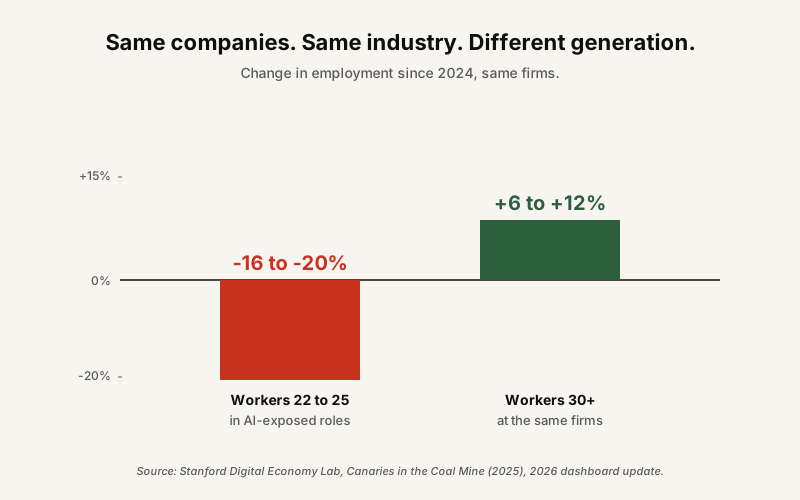
Same companies. Same industry. Different generation. Source: Stanford Digital Economy Lab, Canaries in the Coal Mine (2025), 2026 dashboard update.
Same companies. Same industry. Different generation. Source: Stanford Digital Economy Lab, Canaries in the Coal Mine (2025), 2026 dashboard update.
Both the loud stories in your feed are wrong
Story one: AI is going to take everyone's job by 2027. Panic now.
Story two: AI is a hype cycle. Nobody's actually losing anything. Chill.
The reality doesn't fit either.
Unemployment across OECD countries is at 4.9% right now. Basically fine. The U.S. Bureau of Labor Statistics still projects software developer jobs will grow about 15% over the next decade and data science jobs 33%. The total number of jobs is not falling.
But underneath that flat surface, something is shifting. Companies are getting more productive with the same workers, and instead of doing more, most of them are just hiring fewer new ones. McKinsey asked companies directly. 51% of them said generative AI is reducing their need for entry-level hires.
Half.
So AI isn't really firing people. It's quietly not letting them in.
That is a very different problem, and it does not get solved by the same advice.
The "tasks not jobs" line, but the useful version of it
You've probably heard people say, "AI takes tasks, not jobs."
It's true. It's also the line every AI vendor uses to make people relax. Here's the sharper version.
A job is a stack of tasks. If AI eats 60% of the stack, your job doesn't get cut by 60%. It either disappears entirely, or it turns into something only somebody with judgment, taste, or a real relationship can do.
Which one it becomes depends almost entirely on whether you can do the parts AI can't yet.
If yes, your job just got easier and probably more valuable. If no, someone else at your company just quietly became more valuable than you.
That's the actual mechanism behind the entry-level squeeze. Junior roles are, by design, a bundle of well-defined, well-specified tasks. That is exactly the shape of work AI is best at right now. It is not that juniors are being fired. It is that the entry-level version of every job has fewer tasks left in it than it did three years ago, and companies are quietly reshaping their hiring accordingly.

The jobs actually most exposed aren't the ones you'd guess
If you asked most people which jobs are safest from AI, they'd say something like "doctors, lawyers, CEOs." High-skill, high-pay, white-collar work.
The OECD's 2026 AI exposure measure puts almost the exact opposite at the top of its list. Legislators and senior officials. Managing directors and CEOs. Business services managers. Sales and marketing managers. Software developers. Legal professionals.
That doesn't mean CEOs are getting fired next quarter. It means the tasks their jobs are built from overlap heavily with what AI can already do. Whether that turns into fewer roles depends entirely on whether the productivity gain gets spent on doing more work or hiring fewer people. History says a chunk of it becomes the second thing.
The pattern underneath is simpler than the job titles suggest. Work that is high volume, well specified, and low stakes tends to compress first. Work that is unpredictable, judgement-heavy, or involves being in a room with another human tends to hold.
Physical work is a separate story entirely. Robotics is moving way slower than software AI. If your work involves your hands or moving through unpredictable physical environments, you are on a much slower curve.
What to actually do about it
Enough diagnosis. Three concrete things, based on what the data actually supports.
1. Get fluent with AI, not just familiar with it
The gap between someone who has opened ChatGPT twice and someone who uses it every day for real work is now bigger than the gap between using AI and not using it at all. Anthropic's own research shows experienced users of these tools get dramatically more out of them than newcomers doing the same tasks.
Pick one tool. Use it every day for a month on actual work. Don't stop at the first feature. If the only thing you use it for is "make this email sound better", you're behind. That's the beginner move.
2. Get better at the parts AI is still bad at
Judgement when the answer isn't obvious. Taste. Actual human trust that another person places in you specifically.
AI cannot yet look at a messy situation and say "this is the one thing that matters." It cannot make a customer feel like a person. It cannot decide what a business should even be doing next.
Every one of those is a skill. Most of them aren't taught in school. Build them on purpose. That is exactly why experienced workers in the Stanford data are still being hired at the same firms that are quietly cutting the junior slots. The seniors have more of these things.
3. Learn to run AI, not just prompt it
This is the one most people miss.
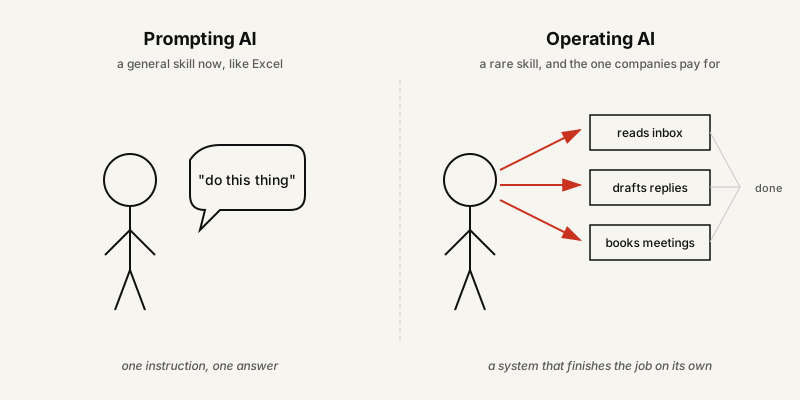
There is a big difference between typing a prompt into a chatbot and building an AI system that runs by itself. The first is a general skill now, like being able to use Excel. The second is rare, and it's the one companies are actually paying real money for, because it's what replaces the five juniors, not what one junior does slightly faster.
If any of this makes you curious what "an AI agent" actually is, here's what an AI agent actually does. Not a chatbot. A whole system that finishes work on its own.
Conclusion
AI is not coming for your job in the movie-trailer sense. It is reshaping which jobs exist, which ones pay well, and which ones still have a ladder for someone new to climb. That change is real, it is uneven, and it is happening faster at the bottom of the ladder than at the top.
If you were hoping for reassurance that nothing is changing, the data doesn't support that. If you were hoping for evidence that everyone is doomed, the data doesn't support that either. What it actually says is more useful than either: figure out which specific slice of the labour market you're standing in, and act on it.
The people who lose to AI over the next five years won't be the ones whose jobs got automated in some dramatic Hollywood moment. They'll be the ones who kept doing everything the same way while the ground under them shifted and didn't notice until the raise didn't come, then the promotion didn't come, then the layoff did.
You just read 1,500 words on this. You're not that person.
Now go actually use the tools.
Want a real read on your own situation?
If you want an honest, non-pitchy look at which parts of your work AI is genuinely ready to handle right now and which parts it isn't, book a free AI opportunity call. No sales team. Just a real conversation about where AI fits in your work and where it clearly doesn't.
Founder & CEO of Rewdle
I'm Ziyan, Founder & CEO of REWDLE. I'm 20 years old, based in Lahore, and I build AI systems (agents, automations, and voice AI) that help businesses cut costs and operate better. Before Rewdle, I grew The AURA TIMES to 30,000+ followers and 100M+ views. I write about what actually works, not what sounds good in a pitch.