The Right Order to Automate Hiring (And the Steps That Will Get You Sued)


Key takeaways
- The average role in the US still takes 42 days to fill. AI is the first thing in a decade to actually move that number.
- Automating in the wrong order is what puts companies in court. iTutorGroup settled with the EEOC for $365,000. The Workday class action just survived a motion to dismiss.
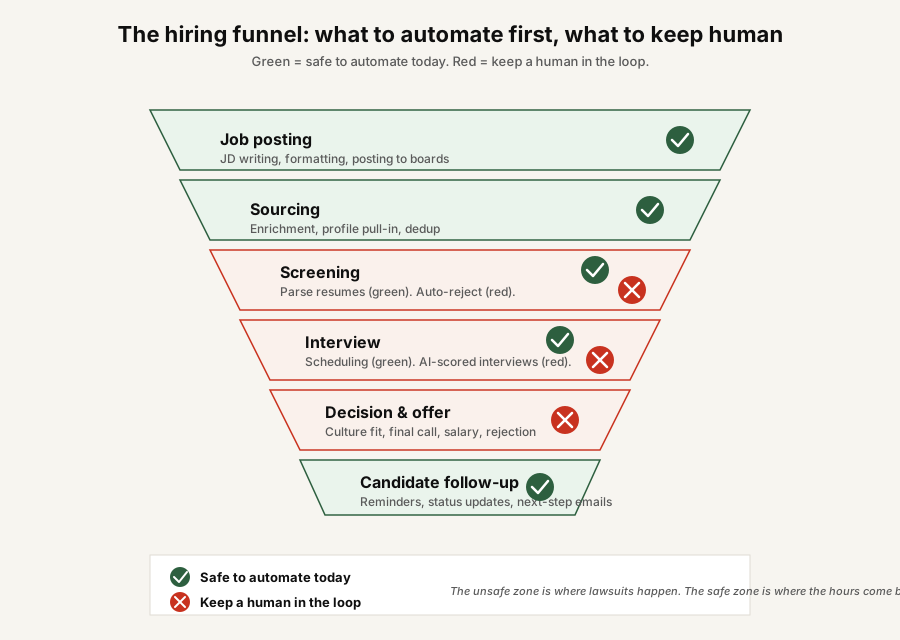
- Safe to automate first, in order: JD writing, resume parsing (extract, not filter), interview scheduling, sourcing enrichment, candidate follow-ups.
- Never automate: final rejection, culture-fit calls, salary decisions, or any decision that closes a door on a candidate without a human seeing it.
- The EU AI Act classifies most hiring AI as high-risk. Enforcement deferred to December 2027, but the obligations and 15 million euro penalties are the same.
- Done well, recruitment automation delivers 20 to 40 percent lower cost per hire and up to 50 percent faster time-to-hire.
You've probably seen the same statistic I have. The average role in the US still takes 42 days to fill, and that number has barely moved in a decade. Every HR tool that promised to fix it added another dashboard and left the number where it was.
Then AI showed up. And for the first time in a long time, the number actually started moving.
Not evenly. Not everywhere. But at companies doing this right, the same recruiter is now handling three or four times the volume, closing hires around half as fast, and spending most of their week on candidate conversations instead of admin work.
At companies doing it wrong, the same technology is generating lawsuits.
Both stories are true in the same twelve months. The difference between them is which step of the hiring funnel you automated first and which one you left alone.
What "recruitment automation" actually covers
To see which step is which, you first need to know that "recruitment automation" isn't one thing. It's a bundle of very different tools that everyone lumps under one word, and it's worth being specific about what you're actually being sold.
Job description generators sit inside it. So does resume parsing. So does interview scheduling, sourcing enrichment, candidate follow-up sequences, AI-powered video interview scoring, and full-on autonomous candidate ranking.
Each of those has a completely different risk profile and a completely different ROI curve. Treating them as one purchase, or one project, is the mistake that trips most teams up.
The useful question isn't "Do we automate hiring?" It's "which specific step do we automate first, which do we automate carefully, and which do we deliberately leave alone?"
The order matters more than most vendor decks let on.
The five safest first steps, in order
If you're a growing team looking at this for the first time, this is the sequence that actually works. It starts with the most obvious wins, ends at the edge of where things get legally interesting, and keeps every step reversible.
1. Job description writing and posting formatting.
Highest ROI per hour, lowest risk. Modern AI tools can draft a job post from a rough spec in about 45 seconds, and the drafts are honestly better than most first-pass human ones. You edit, you post. Nobody gets hurt, nobody gets biased against, and your job posts stop reading like they were pasted from 2011.
2. Resume parsing.
Not filtering. Parsing. There's an important difference. A good parser reads a resume and turns it into structured fields (work history, skills, dates, and education) so a human can actually skim 200 CVs in an hour instead of 20. Modern parsers get about 9 out of 10 CVs right with no manual correction. That's a real productivity number. The keyword to watch: you're extracting, not ranking or rejecting.
3. Interview scheduling.
The single most underrated automation. Manual calendar coordination adds days to time-to-hire and creates about 15 back-and-forth emails per candidate. Automated schedulers integrated with your team's calendars typically cut time-to-interview by close to a third. Nobody misses this once it's gone.
4. Sourcing enrichment.
When you find a prospect on LinkedIn or a job board, automation can pull their public info (recent company, tenure, portfolio links, and published work) into your ATS so a recruiter doesn't tab out to five different places. Same time-saver as parsing, applied to inbound-plus-outbound instead of just inbound.
5. Candidate follow-up sequences.
This is the one candidates actually thank you for. Automated reminders, status updates, and next-step emails do more for candidate experience than any dashboard, because the biggest complaint from candidates in 2026 isn't "the AI is scary". It's ghosting. Ghosting numbers hit a three-year high this year. If your automation keeps candidates informed at every stage, you're solving the actual problem, not the one the demo warned you about.
Notice what those five have in common. None of them make a hiring decision. All of them save time on work nobody's job title says they signed up for.
That's the safe zone. The unsafe zone starts one step later, and it's already in court.
Click to edit alt text & caption
The safe zone is where the hours come back. The unsafe zone is where the lawsuits happen.
The lawsuits nobody in the vendor demo will mention
The moment your automation moves from "extract and organize" to "decide and reject", you're standing in a legal minefield that has already produced settlements.
The part that should worry you isn't just the discrimination claim. It's that a court has now ruled the vendor of a screening tool can be held liable as an agent of the employers using it. Which means the employers can be, too.
That was the June 2026 ruling in the Workday case, where a federal judge denied Workday's motion to dismiss a class action alleging its screening technology discriminates against applicants over 40, by race, and by disability. The plaintiff was rejected from over a hundred jobs on the platform. Four other plaintiffs joined. The case is live.
Workday isn't the first. In 2023 an EEOC lawsuit ended with iTutorGroup paying $365,000 because its AI screener was programmed to auto-reject women aged 55 and up and men aged 60 and up. Two hundred qualified applicants got rejected on age alone before anyone caught it. That's a straightforward violation of the Age Discrimination in Employment Act, and settlements at that scale usually mean a much larger pipeline of cases behind them.
Then there's the EU AI Act, which classifies pretty much every use of AI in hiring as high-risk. Enforcement was originally set for August 2026, then deferred to December 2027 under the Digital Omnibus, so most people have relaxed. Worth not relaxing. The obligations are the same, and the penalties reach fifteen million euros or three percent of global turnover. If your company hires anyone in the EU, or uses a global HR tool that touches EU workers, it applies to you whether you have an EU office or not.
None of this means don't automate. It means know where the line is. The five steps in the previous section sit on the safe side of it. The next section is the line itself.
What must stay a human decision
Some steps are not "automate this carefully." They're "no." Not because AI can't technically do them, but because doing them creates risk out of proportion to the time saved.
Final rejection decisions. If a candidate is being told no, a human should be the one who saw their file and said yes to sending that message. This is the single clearest line for both bias risk and candidate experience.
Culture and team-fit calls. No model, no matter how good, can tell you whether someone will be great to work with. Every model built to try has been shown to reproduce the biases of whoever it was trained on.
Final salary and offer decisions. These require judgement about business context (budget, urgency, comparable roles, the individual's leverage) that AI can inform but should not decide.
Any decision that closes an option for a candidate without a human reviewer in the loop. That's the general rule. If your automation can eliminate a person from consideration by itself, you have a bias risk problem, an EU AI Act problem, and (in the US) a growing EEOC problem.
The heuristic worth remembering: automate everything that saves time. Keep a human on every step that makes an irreversible call about a person.
What that looks like in practice, over 90 days
So what does that principle actually turn into if you're running this at a 20-to-200-person company? Here's the sequence I'd run if I were you.
Weeks one and two: pick one job you're hiring for right now. Roll out just JD generation and interview scheduling on it. Measure the time you save in real numbers, not vibes.
Weeks three through six: add resume parsing (again, extraction only, not filtering). Have your recruiter still make every screening decision, but working from parsed data instead of PDFs. You'll notice you get through the pile about three times faster.
Weeks seven through twelve: add sourcing enrichment and candidate follow-up sequences. This is where your candidate experience score should measurably improve. Watch it.
Somewhere around day 90, you'll be tempted to add automated screening or AI-scored video interviews. That's the exact moment to slow down and read this article again. Everything before that line has a straightforward ROI story. Everything past it has an ROI story AND a legal story, and the second story is the one that costs you the most if it goes wrong.
A few questions worth answering upfront
FAQ block — 4 questions
If you're planning to actually roll this out, how AI agents fit into real hiring workflows is the operational companion to this piece.
Founder & CEO of Rewdle
I'm Ziyan, Founder & CEO of REWDLE. I'm 20 years old, based in Lahore, and I build AI systems (agents, automations, and voice AI) that help businesses cut costs and operate better. Before Rewdle, I grew The AURA TIMES to 30,000+ followers and 100M+ views. I write about what actually works, not what sounds good in a pitch.